
I Tested Gemini 3.7 Flash (2026): Fastest Coding Model at Half Price
Google launched Gemini 3.7 Flash in 2026. Hands-on testing of thinking modes, DeepSWE scores, Artificial Analysis benchmarks, and half-price token economics.


Table of Contents
Google shipped Gemini 3.7 Flash on August 13, 2026, just three weeks after Gemini 3.6 Flash landed. That kind of pace is either impressive or alarming depending on how you look at it, but the numbers behind 3.7 Flash make a decent case that Google wasn't just recycling. The model is Google's described on X as "most intelligent workhorse model yet for coding and agents," and it arrives at half the introductory price of 3.6 Flash. If those claims hold up under scrutiny, this is one of the more significant releases of the year.
The Price Story First Because It Matters
Google is offering 3.7 Flash at $0.75 per 1M input tokens and $3.75 per 1M output tokens as an introductory rate through the end of 2026. After December 31, it reverts to $1.50/1M input and $7.50/1M output. So if you're building something production-facing right now, you have a window. Half the cost of what 3.6 Flash originally launched at, and from what the benchmarks show, considerably more capable—that combination doesn't come around often.
Also, there's a 90% cache discount for previously processed inputs. The effective blended cost (using a 7:2:1 cache hit/input/output ratio) works out to roughly $0.58 per million tokens. For high-volume pipelines or agent workflows that repeatedly reference large contexts, the cache discount alone changes the economics of running this model in production.
The introductory window is real though it expires December 31, 2026, after which pricing doubles. Worth keeping in mind if you're planning an evaluation timeline.
What Changed in Coding Performance
The headline claims for 3.7 Flash center on coding, and the benchmark numbers are hard to dismiss. On FrontierCode 1.1 Main—which measures production code quality—3.7 Flash scores 43.6% compared to 3.6 Flash's 34.4%. On DeepSWE v1.1, which evaluates long-horizon software engineering tasks like real-world issue resolution and debugging, the jump is larger: 65.3% versus 49.0%.
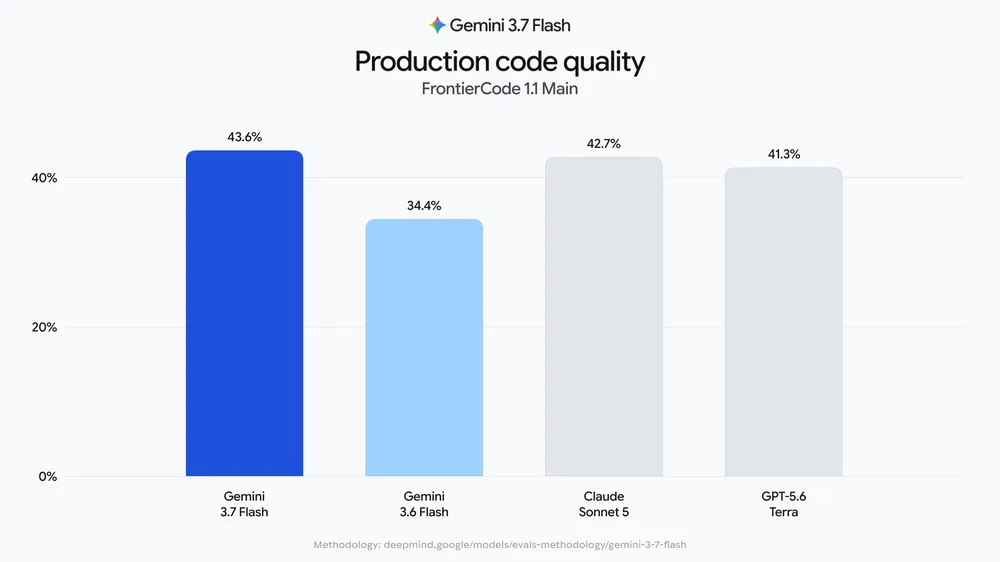
Source: Google's official 3.7 Flash announcement
A 16-point gain on DeepSWE in three weeks suggests the algorithmic changes Google made were aimed squarely at the kind of complex, multi-step coding work that's actually hard—not just autocomplete or single-function generation. Debugging across multiple files, resolving real GitHub issues, handling dependency chains—that's where models historically lose coherence. 3.7 Flash appears to hold together better through those workflows.
Web development is another area where the numbers tell a clear story, cause on Arena.ai's WebDev Arena, 3.7 Flash earns an Elo of 1588 compared to 3.6 Flash's 1538. For UI generation, it shows meaningful design adherence when given a reference screenshot, image, or a full design system as input. Google says it produces more functional layouts and gets closer to feature-complete apps in fewer prompts, which matters quite a bit if you're prototyping or building internal tools where each iteration round-trip costs time and money.
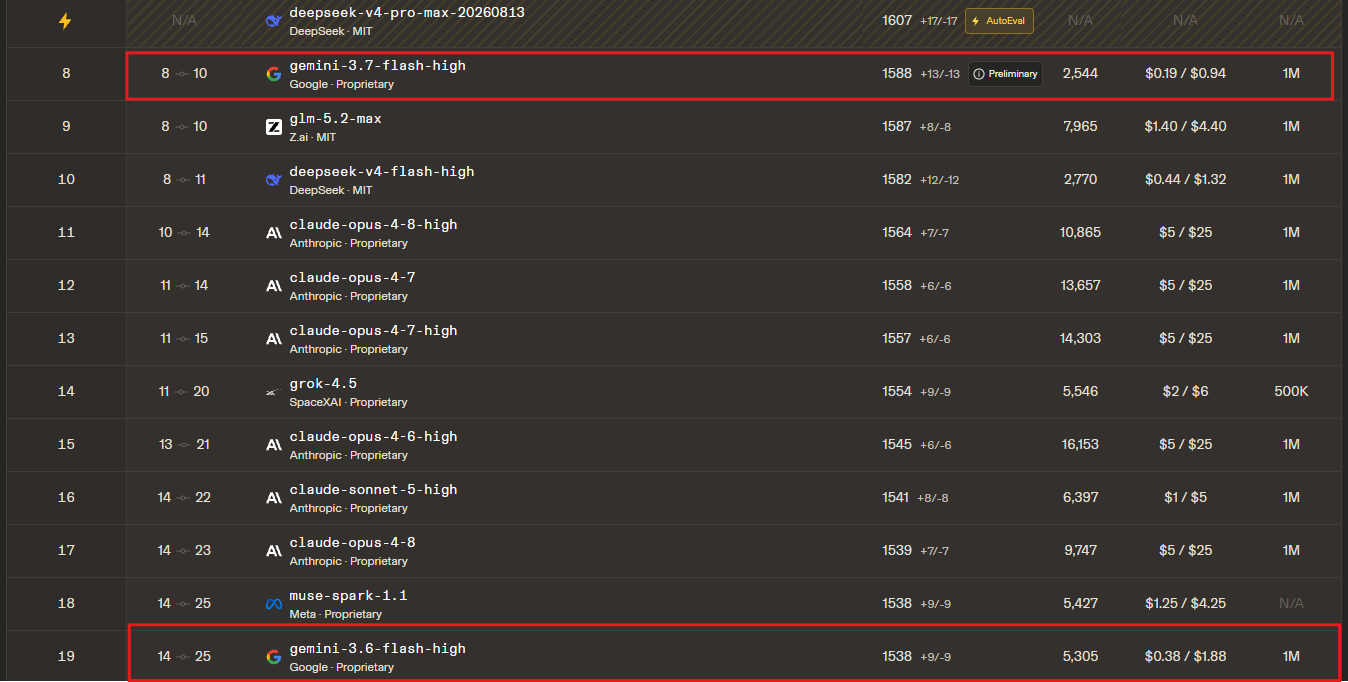
Image Source - Webdev leaderboard
How It Handles Knowledge-Dense Work
Coding is only part of what 3.7 Flash is being positioned for. Google also made specific claims around its performance in fields like finance, law and bioscience—areas where a model getting the reasoning wrong has actual consequences.
On the GDP.pdf benchmark, which tests a model's ability to process and reason over complex expert documents, 3.7 Flash scores 34.0% versus 3.6 Flash's 22.0%. That's a 12-point improvement in understanding the kinds of dense, structured documents that appear in financial filings, regulatory submissions, and scientific literature. On AutomationBench, which measures completion of real-world business workflows end-to-end, the score jumps from 17.0% to 30.4%.
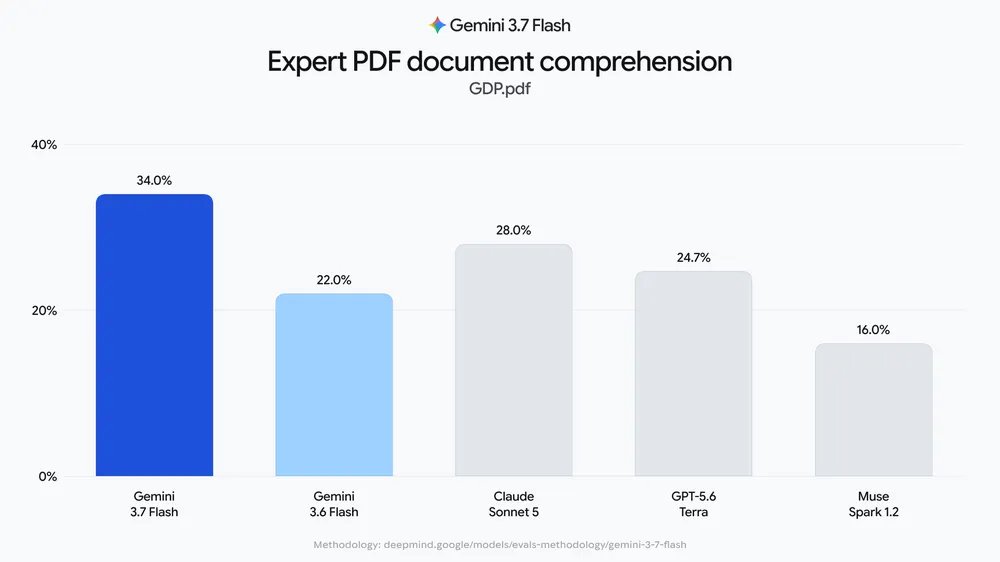
Image Source: Google's official 3.7 Flash announcement
These gains matter for production agents specifically. Real-world agent pipelines don't just write code. They pull from documents, reason over data, interact with business tools, and make decisions across a sequence of steps. A model that reasons more reliably over complex PDFs and follows through on multi-step workflows without going off track is meaningfully more useful in those settings, regardless of how good the code generation is.
The Thinking Modes: Low, Medium, High
One thing third-party benchmarking by Artificial Analysis makes clear is that 3.7 Flash comes with three distinct thinking budget modes—low, medium, and high—each with different trade-offs between speed, reasoning depth, and token usage.
In high mode, the model scores 56 on the Artificial Analysis Intelligence Index and generates output at 340.1 tokens per second — ranking it first out of 187 models in that price tier. Latency to first token is around 9.83 seconds, which reflects the extended reasoning it works through before responding.
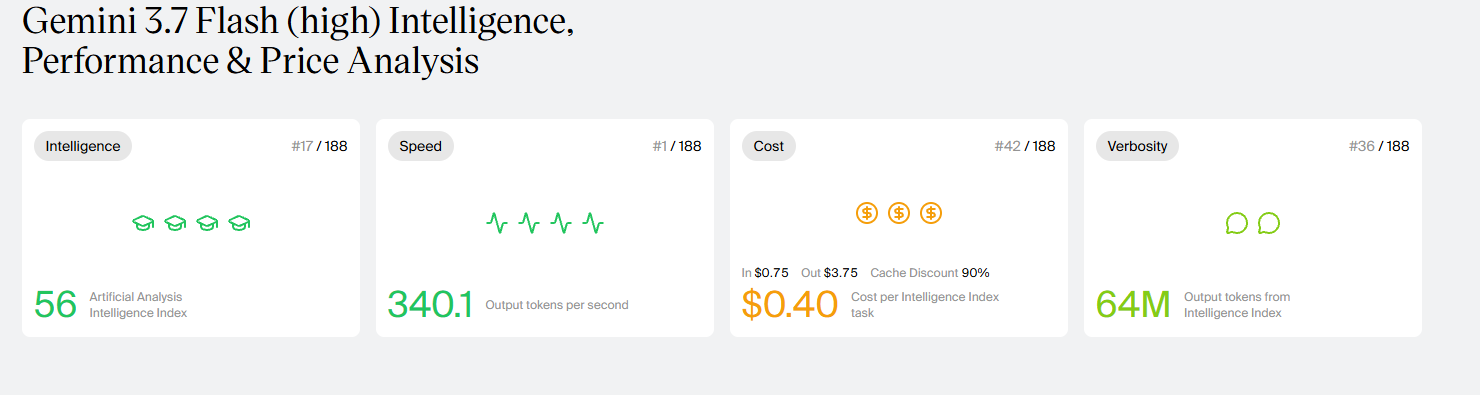
Image source: Artificial Analysis benchmark
In medium mode, the Intelligence Index score is 53, output speed sits at 273.6 tokens/second, and first-token latency drops to 4.22 seconds.
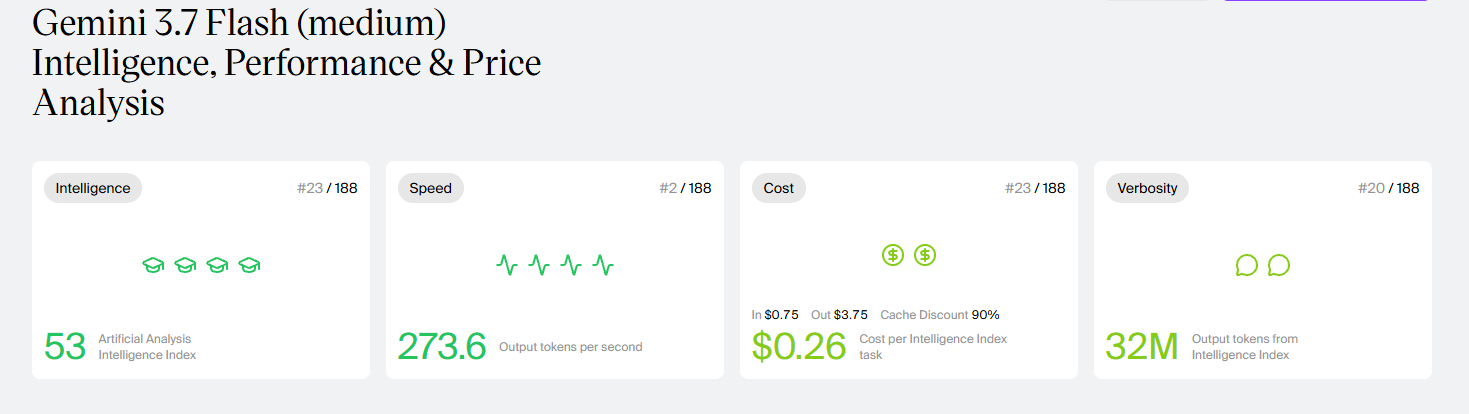
Image source: Artificial Analysis benchmark
Low mode brings the score to 51, speed to 253.5 tokens/second, and latency down to just 0.74 seconds — fast enough to feel nearly instant in most applications.
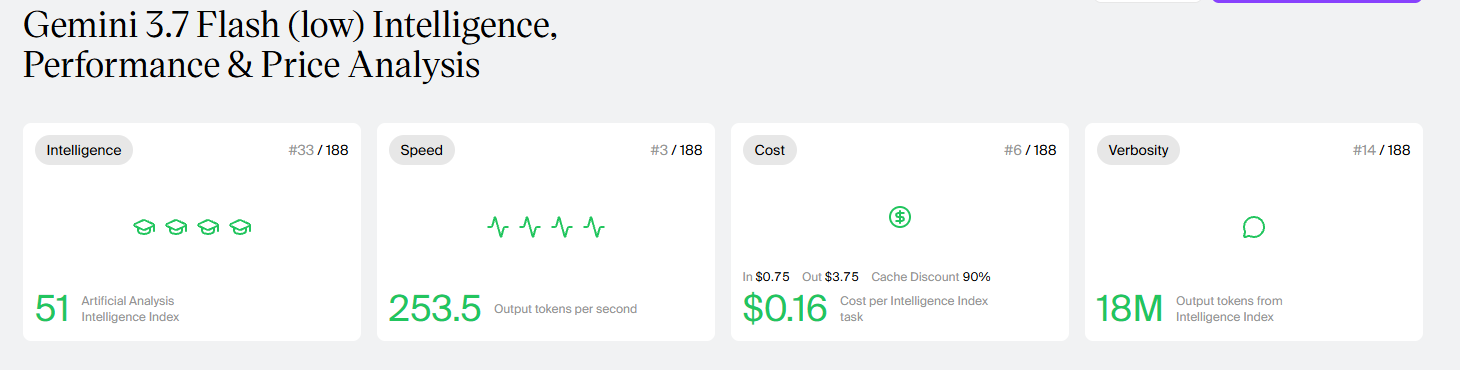
Image source: Artificial Analysis benchmark
All three modes are priced identically at $0.75/$3.75 per million tokens. What changes is the reasoning budget, like how much chain-of-thought thinking the model does before committing to an output. For latency-sensitive or lighter tasks, low mode is the obvious pick. For hard coding or complex document reasoning, high mode is worth the wait. Across all three modes, the context window is 1 million tokens—roughly 1,500 A4 pages of text.
Developer Experience: Less Hand-Holding Required
Beyond raw benchmark scores, Google says 3.7 Flash has improved how it handles execution — better at adapting when it hits a roadblock, better at clarifying intent when a prompt is ambiguous, and more consistent in following multi-step instructions from start to finish. It puts more effort into planning before acting, which translates to fewer cases where it fires off a tool call based on a shallow read of the problem and then has to reverse course.
For simple code generation tasks, this probably doesn't change your experience much. Where it shows up is in agent pipelines that coordinate multiple tools, call external APIs, and make sequential decisions across long workflows. A more deliberate planning phase reduces the number of retries and the amount of manual oversight you need to build in around the model.
Tried It Myself: Portfolio Site in Minutes on Antigravity
I ran 3.7 Flash on Google Antigravity to see how it holds up on an actual task—not a benchmark, just a real build. I gave it a prompt to develop a portfolio for me and it was done in a few minutes. The layout was functional, the code was clean, and it didn’t need much back-and-forth to get there.
Where to Access It
3.7 Flash is available right now through the Gemini API in Google AI Studio and Android Studio, through the Gemini Enterprise Agent Platform on Google Cloud, and via Google Antigravity for agent-first development workflows. Google's official announcement links directly to the developer guide and the model card with full technical specifications. Also, it is available with VS Code Copilot.
Gemini Spark Gets the 3.7 Flash Upgrade
For people using the Gemini app on Google AI Pro or Ultra subscriptions, Gemini Spark—the 24/7 personal agent Google announced at I/O—is now running on 3.7 Flash. The Spark update focuses specifically on tool use within Google Workspace, with improved accuracy across complex, multi-skill workflows: pulling files together, drafting emails, updating project status documents, and similar tasks that span multiple apps.
Spark is available in over 160 countries for AI Pro and Ultra subscribers, though it remains excluded from the European Economic Area, Switzerland, the UK, and Nigeria. If you use Spark regularly for knowledge work, the 3.7 Flash upgrade should show up as a noticeable improvement in how reliably it handles multi-step tasks without stalling or requiring re-prompting.
Safety Updates
Google has updated Frontier Safety safeguards alongside 3.7 Flash, with specific attention to misuse risks in CBRN domains (Chemical, Biological, Radiological, Nuclear) and cyber offence scenarios. The model card is publicly available through Google DeepMind for anyone who needs it for compliance, procurement, or security review purposes.
Quick Benchmark Summary
| Benchmark | 3.6 Flash | 3.7 Flash |
|---|---|---|
| FrontierCode 1.1 Main | 34.4% | 43.6% |
| DeepSWE v1.1 | 49.0% | 65.3% |
| WebDev Arena (Elo) | 1538 | 1588 |
| GDP.pdf | 22.0% | 34.0% |
| AutomationBench | 17.0% | 30.4% |
Source: Google's official 3.7 Flash announcement
Is It Worth Switching From 3.6 Flash?
For teams already using 3.6 Flash in production, the answer depends on what your workloads actually look like. If you're running light, predictable tasks, the gains might not justify the migration overhead. But if you're doing long-horizon coding tasks, building UI from design inputs, running agents over complex documents, or automating business workflows, the improvements are real and the pricing window right now makes the switch easy to justify.
The DeepSWE number (65.3% vs 49.0%) is the one that stands out most. That's not a small improvement in a controlled lab setting—so it's a meaningful difference in how reliably the model handles real software engineering work with less human intervention. Combined with the speed advantage (340 tokens/second at high mode, ranking first among comparable models per Artificial Analysis), 3.7 Flash is difficult to argue against for teams where performance-per-dollar is the metric that matters. The introductory pricing closes at the end of 2026. After that, the cost doubles. If you're going to evaluate this model, the time to do it is now.
Share this publication
Frequently Asked Questions
What makes Gemini 3.7 Flash different from Gemini 3.6 Flash?
Gemini 3.7 Flash delivers a 16-point gain on DeepSWE v1.1 (65.3% vs 49.0%), an upgraded WebDev Arena score (1588 Elo), and introduces three configurable thinking budget modes (Low, Medium, High) at half the introductory price.
How much does Gemini 3.7 Flash cost per million tokens?
Google offers an introductory rate of $0.75 per 1M input tokens and $3.75 per 1M output tokens through December 31, 2026. A 90% cache discount reduces blended costs for high-volume agentic workflows to roughly $0.58/1M tokens.
What are the three thinking modes in Gemini 3.7 Flash?
Gemini 3.7 Flash features Low mode (0.74s latency, 253.5 tokens/sec), Medium mode (4.22s latency, 273.6 tokens/sec), and High mode (9.83s latency, 340.1 tokens/sec)—allowing developers to choose between instant response and deep reasoning.
Where can developers access Gemini 3.7 Flash?
Gemini 3.7 Flash is available in Google AI Studio, Android Studio, Google Cloud Vertex AI / Gemini Enterprise Agent Platform, Google Antigravity, and VS Code GitHub Copilot.
What is the context window size of Gemini 3.7 Flash?
Gemini 3.7 Flash supports a 1-million-token context window (roughly 1,500 A4 pages) across all three thinking modes.
Related Publications

Bring Antigravity Multi-Agent AI into Your IDE - Official Extensions Now Available
Google released official Antigravity extensions for VS Code, Visual Studio, JetBrains, and Zed — bringing multi-agent AI orchestration and shared project context directly to your editor.

Custom Agents Are Now Live in Google Antigravity — Why This Matters for Developers
Google rolls out Custom Agents in Antigravity 2.0 and CLI. Learn how file-based configs, execution symmetry, and lifecycle hooks empower developer teams.